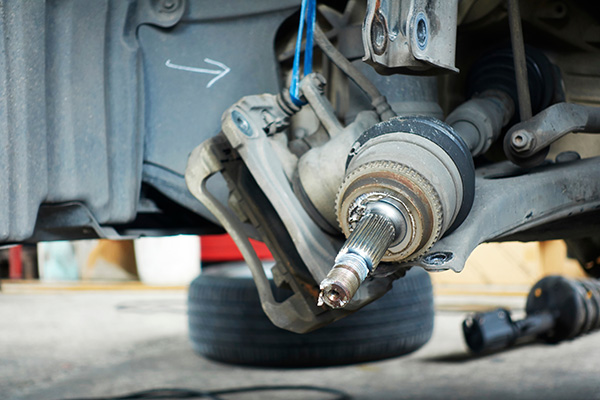
Many drivers hear CV axle and CV joint used as if they mean the same thing. That is understandable because the two parts work together, live in the same area, and fail in related ways. Still, they are not identical parts, and knowing the difference helps when you are trying to make sense of a noise, vibration, or repair estimate.
The short version is simple. A CV axle is the full shaft assembly, while the CV joints are the flexible joints attached to that assembly. One includes the other.
What A CV Axle Actually Is
The CV axle is the shaft that transfers power from the transmission or differential to the drive wheels. On a front-wheel-drive vehicle, these axles are doing a big job every time you accelerate, turn, or pull away from a stop. Many all-wheel-drive vehicles use them, too.
A complete CV axle assembly generally includes the axle shaft itself, an inner CV joint, and an outer CV joint. So when a shop says the CV axle needs replacement, they usually mean replacing the entire assembled unit rather than just one joint.
What A CV Joint Actually Does
CV stands for constant velocity. A CV joint allows the axle to keep transferring power while the suspension moves up and down and the wheels turn left or right. Without that flexibility, the axle would bind up or lose smooth power delivery during normal driving.
Each axle usually has two CV joints. The outer joint handles a greater steering angle, while the inner joint handles more suspension movement and power transfer. Those jobs are slightly different, which is why the symptoms can feel a little different too.
How The Two Parts Work Together
A good way to picture it is to think of the CV axle as the complete arm and the CV joints as the flexible wrists at each end. The axle shaft connects everything, but the joints are what let that power move through angles without jerking or locking up.
That is also why a problem in one CV joint can lead people to say the axle is bad. In everyday conversation, both descriptions get used. Technically, though, the joint is one component, and the axle is the whole assembly that includes it.
What Symptoms Point To A CV Joint Problem
The most familiar sign is clicking while turning, especially during slower turns in a parking lot. That sound usually points to a worn outer CV joint. Once the joint develops enough wear, the internal parts no longer move cleanly under load.
Other clues can show up, too. You might feel vibration during acceleration, hear a clunk when shifting into gear, or notice grease thrown around the wheel area. In many cases, the trouble begins when the rubber boot tears and grease leaks out. Dirt and moisture then get inside, and the joint starts wearing much faster. That is one reason regular maintenance is helpful: a torn boot caught early can save many drivers from a more costly repair.
When The Whole CV Axle Gets Replaced
Even if only one joint is worn, many shops replace the complete CV axle assembly. That approach is common because it is usually more practical and cost-effective than disassembling the axle and replacing just one joint. Labor adds up quickly, and a complete assembly can be a better value.
There is also the bigger reliability issue. If one joint has worn out and the boot has been compromised for a while, the rest of the assembly has already seen the same mileage, heat, and exposure. Replacing the entire unit gives you a more complete fix than patching a single part of an older assembly.
Why Drivers Should Not Ignore Early Signs
A worn CV joint rarely fixes itself or stays at the same stage for long. Clicking during turns can lead to heavier noise, increased vibration under load, and a more unsettling feel from the front end. In a worst-case situation, a badly worn axle or joint can fail enough to leave the vehicle unable to move properly.
The symptoms can also overlap with other issues, which is why it is smart not to self-diagnose too confidently. Wheel bearings, suspension problems, and even tire issues can create noises that sound similar from the driver’s seat. A proper inspection helps separate a true CV problem from something else nearby.
Which Term You Should Use
If you are describing symptoms, either term will usually get the conversation started. Still, it helps to be precise. If you mean the flexible joint at the end, that is the CV joint. If you mean the full shaft assembly running from the transmission to the wheel, that is the CV axle.
In real repair conversations, you will hear both terms because the final repair is commonly a full axle replacement even when the original wear began in one joint. So the difference is technical, but it is still useful to understand. It helps you ask better questions and better understand what your vehicle actually needs.
Get CV Axle Repair In Merritt Island, FL, With Inmon Automotive
If your vehicle is clicking during turns, vibrating on acceleration, or showing signs of a torn axle boot, Inmon Automotive in Merritt Island, FL, can perform an inspection to determine whether the problem is in the CV joint, the full axle assembly, or another nearby front-end component.
Bringing it in early can keep the repair simpler and help you avoid bigger drivability issues later.