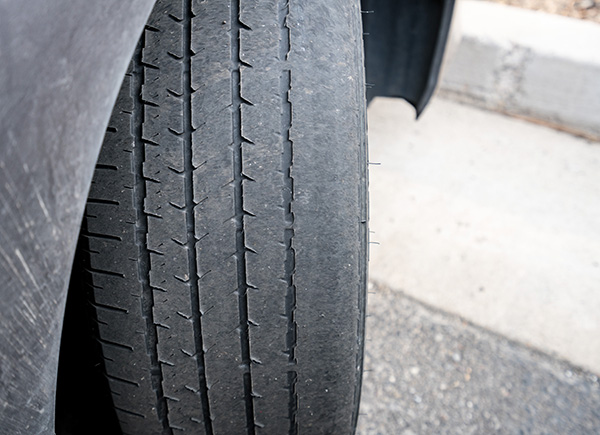
You don't need to wait for the car to slide before checking rain grip. A tread-depth gauge gives you something concrete to look at while the car is parked. The reading needs to come from several places, because a tire with a healthy-looking center can still be worn along one shoulder.
Measure Tire Tread Across the Full Width
Park safely on a level surface, apply the parking brake, and switch the vehicle off. Place the gauge in a main tread groove with its base sitting flat across the surrounding tread. Avoid resting the probe on a raised wear bar, since that gives the wrong picture of the groove depth. Read the tool according to its instructions.
Measure the inner, middle, and outer portions, then repeat around the tire and on the other tires. If you can't reach or see the inside edge safely, have it checked at the shop. Don't crawl under an unsupported vehicle. Keep a simple note of the lowest readings so the next inspection shows how the wear is progressing. Mark each tire's position beside its reading to avoid mixing them up later.
What 4/32 Inch and 2/32 Inch Mean in Rain
Tread grooves help move water away from the contact area. As they get shallower, the tire has less ability to clear deeper water. Wet-road braking tests support considering replacement around 4/32 inch for drivers who regularly encounter rain. That is a planning guideline for wet performance, not a promise that any tire above it will keep grip in every storm.
The wear bars in many passenger tires sit at about 2/32 inch. Once the surrounding tread reaches those bars, replacement is overdue for the kind of wet-road margin most drivers want. A tire near that point shouldn't be judged ready for heavy rain simply because a few grooves are still visible.
A Coin Check Is a Quick Screen, Not a Full Tire Inspection
A quarter placed with Washington's head downward into a groove can help screen for roughly 4/32 inch. If the tread doesn't reach the top of the head, arrange a more accurate measurement. A gauge makes it easier to compare across all grooves and tires. A penny check looks at a shallower threshold, so it can miss the earlier replacement discussion that makes sense for frequent rain.
Coins don't reveal internal damage, aging, or how well the tire fits the car. The sidewalls and the whole tread still need looking over. A bulge, cut, or exposed cord changes the decision regardless of a good reading somewhere else on the tire.
Uneven Tire Wear Needs Its Cause Found
One low shoulder can come from alignment or a worn suspension joint. Incorrect pressure affects wear too. We inspect the tire and wheel, check the suspension as needed, and measure alignment when the findings call for it. Replacing the tire alone leaves the next set exposed to the same wear. Bring any history of repeated pressure loss, steering pull, or a recent pothole impact. Those details help explain how the pattern developed.
Tread Depth Doesn't Set a Safe Speed for Standing Water
Even deep grooves have limits. Vehicle speed, water depth, pressure, and tire design affect the point where a tire begins riding over water. Reduce speed before reaching pooled water and leave more following distance. Avoid sudden steering or braking inputs, and don't enter water when you can't determine its depth or the road surface.
If the steering starts feeling light or the car loses grip, ease off the accelerator and keep your inputs gentle while traction returns. Don't treat the tire check as a reason to maintain normal speed through a downpour. The road conditions still decide how much room and speed reduction the drive needs.
Compare All 4 Tires Before Christmas Travel
A single good tread reading doesn't describe the whole car. We compare the set for size, wear, damage, and the pressure it should run at. If tires need replacement, the axle placement and any AWD rolling-size requirements guide the plan. An apparently good front pair doesn't cancel poor grip from worn rear tires.
Check again before a long trip, especially if the last measurement was several months ago. Tire condition changes with mileage, and wear can accelerate after an alignment or suspension problem develops. Schedule the visit while there is time to order the correct fitment and investigate the wear, not just mount whatever is immediately available.
Get Tire Tread Checks In Merritt Island, FL, With Inmon Automotive
Inmon Automotive in Merritt Island, FL, can measure your tread and check uneven wear before rainy holiday travel. Mention any recent pulling, vibration, or pressure warning.
Bring the car in for a full tire check before deciding that visible grooves mean it's ready for heavy rain.